Why Choose a Guitar Instructor When You Can Learn From YouTube?
There has never been a better time to learn guitar on your own. YouTube is filled with thousands of guitar lessons, song tutorials, technique demonstrations and exercises, all available for free.
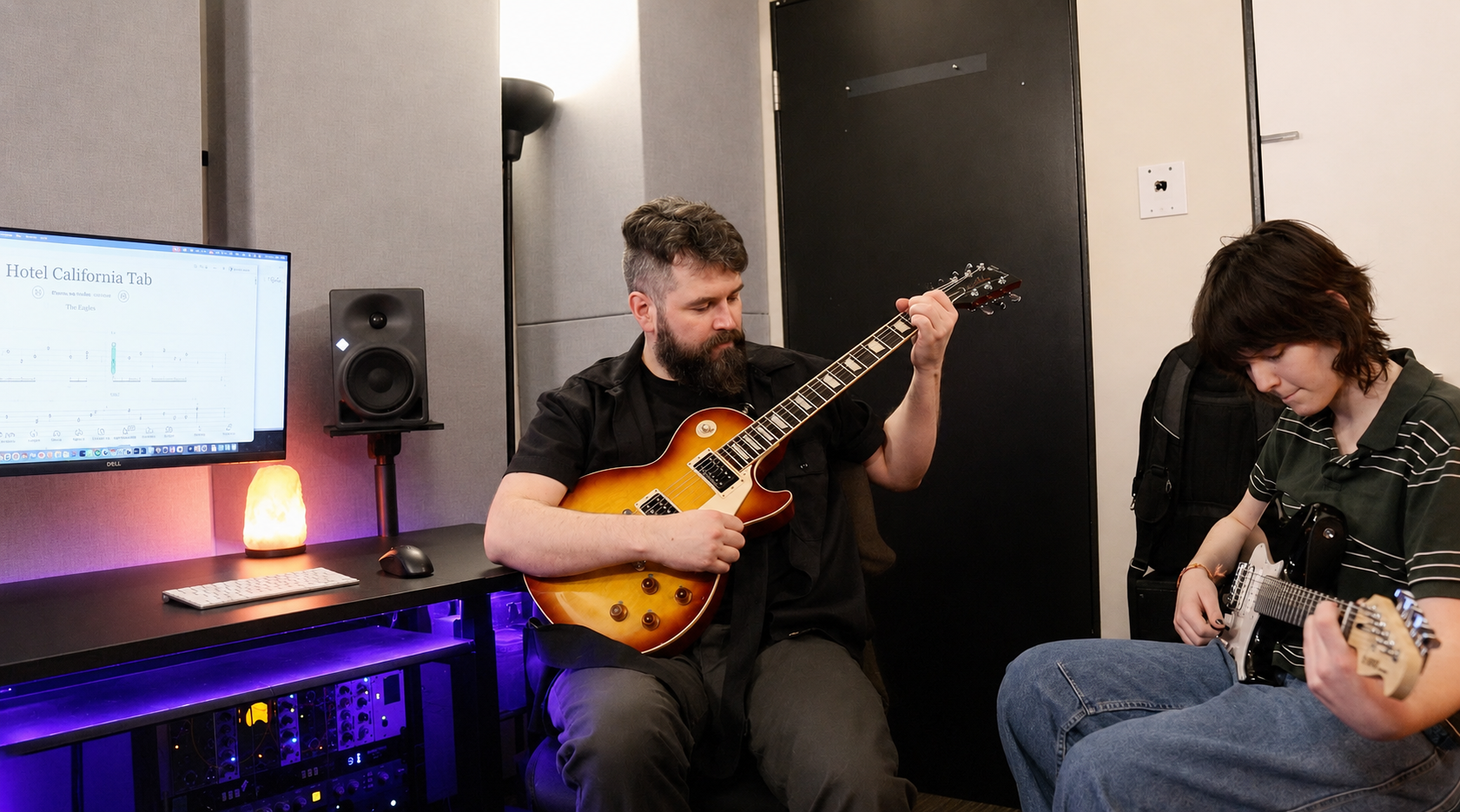
So why pay for a guitar instructor?
It’s a fair question. In fact, I think YouTube can be an excellent tool for learning guitar. I regularly encourage my students at Blue Guitar Studio in Vancouver to use it as a supplement to their lessons.
But after teaching guitar for many years, I’ve noticed a consistent pattern: there is a big difference between having access to guitar information and actually being taught how to play.
Many of my students come to me for guitar lessons after spending months or even years learning from YouTube. They’ve learned chords, riffs, songs and techniques. Some can play quite a lot of material.
But almost every one of them has struggled with some of the same things, particularly rhythm, strumming, song selection and the small technical details that are difficult to recognize when you’re learning entirely on your own.
Playing a Song vs. Actually “Playing” a Song
One of the biggest differences I notice with students who have learned primarily from YouTube is rhythm. A student may be able to play all the chords in a song and make it from beginning to end. Technically, they are “playing the song.”
But there’s a huge difference between simply getting through a song and actually playing it with the correct rhythm, feel, accents, dynamics and timing. This is particularly noticeable with strumming.
A YouTube guitar tutorial can show you the chord progression and demonstrate a strumming pattern. But learning rhythm isn’t simply a matter of memorizing whether your hand moves “down, down, up, up, down, up.” There’s much more happening.
Where exactly does the strum fall in relation to the beat? Which strokes should be accented? Which should be lighter? Should your hand continue moving even when you aren’t actually hitting the strings? How does the rhythm change when you move from one chord to another? How do you make the part feel natural rather than mechanical?
These are things that are much easier to understand when another musician can actually listen to you play and point out what needs to change. Rhythmic notation can also be difficult for beginners to interpret without someone demonstrating how it relates to what their hands are actually doing.
This is one of the areas where I see the limitations of learning exclusively from YouTube. You can watch someone demonstrate a rhythm perfectly, but the video doesn’t know what you’re doing incorrectly. A guitar teacher does.
YouTube Gives You Everything, Which Can Actually Be the Problem
Another challenge for beginner guitar players is simply knowing what to learn.
YouTube has an almost infinite amount of guitar material. That’s an incredible resource, but for a beginner it can also be overwhelming.
Should you learn scales?
Bar chords?
Pentatonic patterns?
Open chords?
Fingerpicking?
Alternate picking?
Music theory?
Or should you just learn songs?
And then there’s the question of which songs.
A beginner might choose a song they love only to discover that it’s far beyond their current ability. They struggle through it for weeks, develop poor habits, become frustrated and eventually stop practicing.
On the other hand, if everything they play is far below their ability, they’re not really progressing either. Good guitar instruction involves finding that sweet spot: material that is challenging enough to encourage growth without being so difficult that it becomes overwhelming. That’s something I do with my students constantly.
As you improve, the material should change with you.
Sometimes the right lesson is a song you’ve always wanted to learn. Sometimes it’s a technique you need to develop. Sometimes it’s something much less exciting, but something that will make everything else you’re trying to play considerably easier. That kind of curation is difficult to get from an algorithm.
The Small Movements That Make a Huge Difference
Playing guitar is an incredibly coordinated physical activity.
Your fretting hand, picking hand, fingers, wrist, arm, posture, timing and sense of rhythm all have to work together. And sometimes the thing holding you back isn’t something obvious. It can be a tiny movement that you’re not even aware you’re making. This becomes particularly important with picking technique.
I’ve experienced this myself.
For years, even as a professional guitarist, I was picking in a way that wasn’t particularly economical. I had developed movements that worked, but eventually I reached speed barriers that I simply couldn’t seem to break through.
It wasn’t until I started studying more advanced picking concepts, including techniques involving wrist supination and escape motions, that I began to understand what was actually happening with my picking hand.
Exploring concepts such as upward- and downward-escape motions completely changed the way I approached picking and helped me break through speed plateaus that I had been stuck at for years.
The important lesson for me was that the problem wasn’t a lack of practice. I had already practiced for thousands of hours. The problem was what I was practicing and the mechanics behind the movement.
That’s another limitation of learning exclusively from videos. You can watch a highly skilled guitarist demonstrate a technique and try to copy what you see, but there may be subtle movements happening in your own hands that you simply can’t recognize.
Sometimes you need another experienced guitarist to look at your technique and say:
“Try moving your wrist this way.”
Or:
“You’re using far more movement than you need.”
Or even:
“The problem isn’t your speed. It’s the movement you’re using to produce the speed.”
Those tiny corrections can make a tremendous difference.
A Guitar Teacher Doesn’t Replace YouTube
I don’t think guitar teachers need to compete with YouTube.
In fact, I think YouTube is fantastic.
There are musicians and educators on YouTube who have created an enormous amount of valuable material, and I use online resources myself.
The difference is that YouTube gives you information. A teacher gives you direction.
A good guitar instructor can look at where you are today, understand where you want to go, identify what’s holding you back and help you determine what to work on next.
You can still use YouTube for inspiration, demonstrations, different perspectives and additional practice material.
But instead of trying to figure everything out yourself, you have someone helping you navigate the enormous amount of information that’s available.
Adult Guitar Lessons: Learning Around Your Goals
Many adults come to guitar lessons after learning on their own for a while, returning to the instrument after a long break or finally deciding to learn something they’ve wanted to play for years.
One advantage of adult guitar lessons is that the material can be built around what you actually want to accomplish.
You might want to play songs for fun, improve your rhythm, understand more music theory, develop your lead playing or finally get past a technical problem that has been frustrating you for years.
There doesn’t have to be a one-size-fits-all path.
For adults with limited practice time, knowing what to focus on can also make that time much more productive.
The Human Connection
There’s one final reason to have a guitar teacher that has nothing to do with technique. It’s the relationship.
Many of our students have been taking guitar lessons with us for years. When you see someone every week for years, you naturally get to know each other. We talk about guitar, but we also talk about life.
You see someone’s progress, not just as a musician, but as a person. You celebrate their successes, hear about their families, their work, their travels, their challenges and all the little things that happen between lessons. In many cases, I see my students more regularly than I see some of my own friends and family. At that point, they stop feeling like “students.” They’re friends that I get to see every week. That’s something YouTube can’t provide.
Looking for Guitar Lessons in Vancouver?
If you’re looking for guitar lessons in Vancouver, personalized instruction can give you something that an online video simply can’t: direct feedback on your playing.
At Blue Guitar Studio, lessons are tailored to the individual student rather than built around a rigid curriculum.
Whether you’re a complete beginner, an intermediate player who feels stuck or an experienced guitarist looking to improve your technique, the goal isn’t simply to give you more information.
It’s to help you understand what to practice, why you’re practicing it and how to make measurable progress.
YouTube can show you how someone else plays. A guitar instructor can listen to how you play.
And sometimes that’s the difference between practicing the same problem for another year and finally breaking through it.
So, Should You Use YouTube to Learn Guitar?
Absolutely. If you’re motivated and curious, YouTube can be an incredible supplement to your guitar education.
But if you’ve been learning on your own and feel like you’re stuck, frustrated, unsure what to practice, or able to play songs but not quite able to make them sound right, it may be time to have another guitarist take a look at what you’re doing.
Sometimes you don’t need more information. You need feedback, direction and someone who can hear and see what you’re actually doing. And that’s ultimately what a good guitar instructor provides.
YouTube can show you how to play a song. A teacher can help you learn how to play guitar.
Frequently Asked Questions
Can you really learn guitar from YouTube?
Yes. YouTube can be an excellent resource for learning guitar, particularly for discovering songs, techniques and different approaches to playing. The challenge is that videos can’t listen to your playing, identify your specific problems or create a learning path based on your individual ability.
Is it better to learn guitar with a teacher or YouTube?
It doesn’t have to be one or the other. YouTube is a valuable supplement to guitar lessons, while a teacher provides personalized feedback, structure and direction. Using both can be an effective way to learn.
Are guitar lessons worth it for adults?
Yes. Adult guitar lessons can be particularly useful because they can be tailored to your goals, musical interests, experience level and available practice time.
Adults often come to lessons with very specific goals, whether that means learning favourite songs, returning to guitar after years away or improving a technique they’ve struggled with on their own.
Can a guitar teacher help me improve my rhythm and strumming?
Yes. Rhythm and strumming are areas where direct feedback can be particularly valuable. A teacher can listen to your playing, identify timing problems and help you understand how strumming patterns, accents and rhythmic notation translate into actual playing.
How do I know which guitar songs I should learn?
The best songs to learn are usually ones that are interesting to you while also being appropriate for your current ability. A guitar instructor can help choose songs that provide enough challenge to encourage progress without being so difficult that you develop poor technique or become frustrated.
Can a guitar teacher help with picking technique and speed?
Yes. Picking speed often isn’t simply a matter of practicing faster. Small changes in wrist, hand and arm movement can have a significant effect on efficiency. A guitar teacher can observe your picking technique and help identify movements that may be limiting your speed or causing unnecessary tension.
Are guitar lessons worth it if I already use YouTube?
If you’ve been learning from YouTube successfully and are happy with your progress, keep using it.
But if you find yourself repeatedly getting stuck, struggling with rhythm, unsure what to practice or developing techniques that don’t feel efficient, personalized guitar lessons can help you identify and overcome those problems much more quickly.
How do I find the best guitar lessons in Vancouver?
The best guitar lessons in Vancouver will depend on your goals, experience level and learning style.
Look for an instructor who can adapt lessons to your interests, explain technique clearly, provide useful feedback and choose material that is appropriate for where you are right now. A good teacher should help you become a better independent musician rather than simply give you more things to practice.
Ready to Take the Next Step?
If you’ve been learning guitar on your own and feel like you’ve hit a wall, personalized instruction can help you figure out what to work on next.
Blue Guitar Studio offers guitar lessons in Vancouver for beginners, intermediate players and experienced guitarists, including adult guitar lessons tailored to your goals, interests and playing style.
Get in touch to book a lesson or learn more about guitar lessons at Blue Guitar Studio.